
For a long time now, I stopped using WillCycle to do direct cycling advocacy, but something happened recently that forced my hand, hence this post.
Devon and Cornwall Police and I have a bit of a history. When I originally started making complaints about bad driving, with supporting video, I was laughed off. An Inspector said I was a troublemaker, and that if things were as bad as I claimed, they’d be inundated with complaints. He went on to say that I was the only cyclist making reports.
I took to social media, asking cyclists in Devon and Cornwall to start making reports, and explaining what the good Inspector had said. Within three months, that same Inspector admitted they were overwhelmed with more reports that they could deal with.
Op Snap
When the West Midlands Police introduced Op Snap – a system that allowed cyclists to report dangerous close passes, Devon and Cornwall Police refuses to attend sessions run by West Mids. The West Mids cops were trying to show other forces how easy it was to implement, and how effective it was. After all, it meant that ordinary people were doing much of police’s work for them.
It was during that time I had a BIG run-in with D&C Police. Ultimately, that ended with their Roads Policing team doing a complete U-turn, and they also implemented Op Snap. All good, right?
Backsliding
More recently, D&C Police’s Op Snap team seem to be slowly reverting back to old, nasty habits. I’m one of a group of cyclists who used to regularly meet with the Op Snap team. Over time, we educated them on how to interpret videos, why a cyclist might not have swerved, and more. Yes, D&C Police once refused to act, unless a cyclist wildly swerved/braked/called out in fear! Honestly, that’s frankly ridiculous behaviour, from a profession that prides itself on being evidence-led.
That group of cyclists share the perception that the Op Snap team have been seriously backsliding.
The Close Pass
On the 29th of June, 2026, I was cycling in Plymouth, when I suffered a very close pass from an irate Audi driver. The video of that is further below. Now here’s the thing: if you’re not used to looking at helmet cam video, you might say “He was MILES away!”
Because most of the Op Snap team have a windscreen-shaped view of the world, I always try an implement as much concrete evidence into my reports, in addition to the video, as what I can get. Yes, that does mean I regularly return to locations where I suffered a close pass, to measure the road with a tape measure.
Here’s the report I wrote for that particular close pass:
On the 29/06/2026, at around 15:10, I was cycling in an easterly direction, along Glen Road, Plympton, Plymouth. It was a bright day, and I was wearing a bright blue cycling jersey, with lots of white. Visibility was very good. In addition, because my bike has dynamo lights, I was riding with lights on. Also, the rear of my right-hand pannier, I have a Pass Pixie hivis sign. I am confident I made myself very visible.
Glen Road isn’t wide enough for a car to safely pass a cyclist, without almost completely moving into the oncoming lane (when safe to do so). As a result, as per DfT advice, I was riding in the middle of the lane, to try and discourage unsafe close passes.
There was another cyclist, who was riding on the tarred strip on the pavement to my left. That is not a shared pavement, and cycling there is not permitted.
When the driver of the Audi overtook, close-passing me, the passenger window was open, and he was pointing to the left, and shouting something unintelligible. To me, this suggests the close pass was deliberate and intentional, as the driver appeared visibly upset about my absolutely legal road positioning.
The lane where the incident occurred is 3.79 metres wide, and as the video clearly shows, I was riding in the middle of the lane, leaving around 1.89 metres of free space to the right of my bike’s wheels. The Audi is an S3 Super S, which is 1.9 metres wide. As the video will show, more than three quarters of the car was within my lane when the driver overtook me. Three quarters of that car is 1.42 metres, and when deducted from the free lane space to the right of my bike’s tyres, it reduces the space between the car and my bike to just 0.47 metres.
My bike with panniers on is 0.68 metres wide, with half of that either side of the wheels. That further reduces the space between the car and me to just 0.13 metres.
The Highway Code says drivers should give cyclists 1.5 metres space when overtaking at speeds of up to 30 mph.
Here’s the video of the incident:

The Reply
I genuinely expected Op Snap to issue that driver with a Notice Of Intention To Prosecute (aka a NOIP). By law, police have just 14 days to do so. Should they fail to issue a NOIP in the 14 days, the driver gets away with it.
Here’s the 1st reply I had from the Op Snap team – I highlighted certain elements in bold:
Thank you for your email.
You have stated that you have chosen to ride in the centre of the lane “to try and discourage unsafe close passes. This would suggest that you are putting yourself in charge of traffic control. This is a practice that is not encouraged and could potentially put you and other road users at risk.
On viewing this footage, I can see that this road at the time is not busy and there is no oncoming traffic. The lane you are position in is not narrow and there are no obstacles to prevent you from moving to the left to allow faster moving vehicles to safely overtake safely as per the Highway Code.
The driver of the vehicle has moved to the opposite carriage way as can be seen by the central broken white lines. If you had positioned to the left of this lane the driver would have given you plenty of room and indeed, I believe gave you room despite your positioning. Also, you have turned your head to look at the driver which distorts the view of the space between yourself and the vehicle.
I have no view of your cycle and therefore cannot comment on the measurements you have supplied in relation to the size of your cycle or panniers. In any case these cannot be calibrated.
You state that on this occasion it was a bright day and in addition you have taken extra care to make yourself as clearly visible as possible.
On this occasion it would be difficult to positively progress your submission and it could be argued that you contributed to your perception of this close pass by placing yourself in a position of authority on the road.
Although your submission will not be progressed any further, we look forward to hearing from you again as we consider your submissions valuable and appreciate your contributions and support for road safety.
Thank you
Operation Snap
Road Safety Team
The short version of that is simply “You numpty! Why were you riding in the middle of the lane, instead of the gutter? The close pass was ALL your fault! Read the Highway Code!”
Let’s examine it, shall we?
1. Cycling in the centre of the lane is not encouraged
That’s a frankly bizarre thing for police to claim, and of course it’s utter codswallop. On their own website, Devon and Cornwall Police say this: “Be aware that legally, a cyclist can use the entire lane and will often take a mid-lane position to deter overtaking at vulnerable locations, like narrow roads, junctions, and blind bends.” On that same page, it also states “Riding too close to the kerb could be dangerous for cyclists; it is safer to ride in the middle of the lane if there is not enough room for a car to overtake.”
That’s not all, though. The government’s Think road safety site has this to say: “You may ride in the centre of your lane, known as the ‘primary position’, on quiet roads, in slower-moving traffic and at the approach to junctions or road narrowings.”
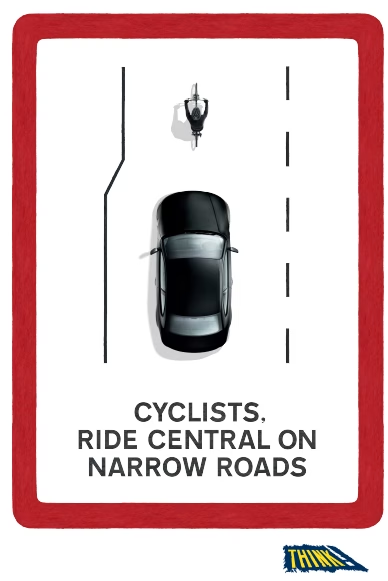
The Think campaign is also responsible for this poster, which I used as the image at the top of this post.
The Highway Code, under Rule 72, has this to say: “Ride in the centre of your lane, to make yourself as clearly visible as possible, in the following situations: on quiet roads or streets – if a faster vehicle comes up behind you, move to the left to enable them to overtake, if you can do so safely
in slower-moving traffic – when the traffic around you starts to flow more freely, move over to the left if you can do so safely so that faster vehicles behind you can overtake
at the approach to junctions or road narrowings where it would be unsafe for drivers to overtake you
A different police force has this to say, clarifying what we know is legal: “Legally, a cyclist can use the entire lane.” Yes, cyclists may legally choose to ride to the left, in the middle, or even to the right of the lane. You’d expect police to know this.
Quite clearly, the Op Snap team is – at best – being disingenuous in what they claimed.
2. Move left to allow faster vehicles to overtake, as per the Highway Code
Specifically, they said this: “On viewing this footage, I can see that this road at the time is not busy and there is no oncoming traffic. The lane you are position in is not narrow and there are no obstacles to prevent you from moving to the left to allow faster moving vehicles to safely overtake safely as per the Highway Code“.
Let’s again examine what the Highway Code actually says: “on quiet roads or streets – if a faster vehicle comes up behind you, move to the left to enable them to overtake, if you can do so safely“.
The Highway Code places the full responsibility of deciding when it’s safe to move left on the cyclist alone. It’s certainly not a case of “move left if a driver is getting even slightly annoyed.” The Highway Code is clear: when you feel it is safe to do so.
On that particular road, moving left simply results in drivers squeezing past, despite oncoming traffic, without leaving the lane. THAT IS UNSAFE TO ME! The road isn’t particularly narrow, but is too narrow to allow drivers to overtake without mostly leaving the lane, unless they do dangerous close passes. That effectively means the road comfortably meets the requirement to cycle centrally.
But why would police choose to misinterpret the Highway Code?
3. It’s YOUR fault, for not moving left!
They may not have used those exact words, but that is effectively the meaning of what they said, and I’m only slightly surprised they didn’t tag on “Oh look, that poor, innocent driver was inconvenienced, you monster!”
As we’ve already very clearly established, cyclist are recommended to cycle in the centre of the lane, where not doing so can lead to unsafe overtakes. What the Op Snap team did was to victim-blame me, and it makes me shudder when I think about how much victim-blaming their response to a rape victim might contain: “But you were wearing a mini-skirt, weren’t you?”
Attitudes like that belong in 1975!
Don’t even get me started about their ludicrous claims of “you contributed to your perception of this close pass by placing yourself in a position of authority on the road”.
To be crystal clear: it wasn’t a perception of a close pass. It WAS a close pass, and a vindictive, deliberate one at that. Yet police blame me?
The aftermath
This whole sorry saga is far from over. Upon receiving that response, I immediately made a formal complaint about it, which (as I’m writing this) is with Professional Standards.
However, I have since been explicitly told by the Section Head for Op Snap, David Beckenkrager, that they will NOT reverse their decision, and they will NOT take action against this driver. In my complaint, I did question whether someone in the Op Snap team knows the driver, but I guess I’ll never find out.
Anyone who disagrees with my view that this driver should’ve been prosecuted is more than welcome to go double-check the calculations I gave. While of course I’ll be first to acknowledge that my calculations do contain at least a degree of uncertainty, I also erred on the side of caution. For example, I only used 3/4 of the car’s width, when less than 1/4 was out of the lane.
No matter how you slice it, this was a nasty, intentional close overtake – something we call a punishment pass – and police, though their refusal to act, are condoning it.
I’ll update this sorry saga with the outcome of my complaint, but I fully expect that I will need to escalate it far higher yet.